

Sunday, February 23, 2014

Thomas Merton on Latin Chants

This is what I think about the Latin and the chant: They are masterpieces, which offer us an irreplaceable monastic and Christian experience. They have a force, an energy, a depth without equal. All the proposed English offices are very much impoverished in comparison–besides, it is not at all impossible to make such things understood and appreciated. Generally I succeed quite well in this, in the novitiate, with some exceptions, naturally, who did not understand well. But I must add something more serious. As you know, I have many friends in the world who are artists, poets, authors, editors, etc. Now they are well able to appreciate our chant and even our Latin. But they are all, without exception, scandalized and grieved when I tell them that probably this Office, this Mass will no longer be here in ten years. And that is the worst. The monks cannot understand this treasure they possess, and they throw it out to look for something else, when seculars, who for the most part are not even Christians, are able to love this incomparable art. -Thomas Merton
Sunday, February 2, 2014

Sunday, January 12, 2014
UNDERSTANDING WHEN TO KNEEL, SIT AND STAND AT A TRADITIONAL LATIN MASS - By Richard Friend
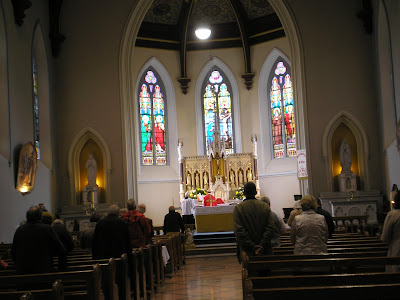
Excerpt
from: Understanding When To Kneel Sit And Stand
At A Traditional Latin Mass - A Short Essay On Mass Postures - by Richard Friend
A Catholic assisting
at a Traditional Latin Mass for the first time will most likely experience
bewilderment and confusion as to when to kneel, sit and stand, for the postures
that people observe at Traditional Latin Masses are so different from what he is
accustomed to. To understand what people should really be
doing at Mass is not always determinable from what people remember or from what
people are presently doing. What is needed is an understanding of the nature of
the liturgy itself, and then to act accordingly.
When I began assisting
at Traditional Latin Masses for the first time as an adult, I remember being
utterly confused with Mass postures. People followed one order of postures for
Low Mass, and a different one for Sung Mass. I recall my oldest son, then a
small boy, being thoroughly amused with the frequent changes in people’s
postures during Sung Mass, when we would go in rather short order from standing
for the entrance procession, kneeling for the preparatory prayers, standing for
the Gloria, sitting when the priest sat, rising again when he rose, sitting for
the epistle, gradual, alleluia, standing for the Gospel, sitting for the
epistle in English, rising for the Gospel in English, sitting for the sermon,
rising for the Credo, genuflecting together with the priest, sitting when the
priest sat while the choir sang the Credo, kneeling when the choir reached Et incarnatus est etc. (we should have been
bowing while seated), sitting again for the rest of the Credo, rising when the
priest rose, sitting for the offertory, etc. Not knowing any better, I simply
followed what other people were doing, and what other people were doing was
following the postures indicated in the Latin-English booklet missal published
by Coalition in Support of Ecclesia Dei (hereinafter the “red booklet”).
Over time I began to question the order of postures
that people followed, particularly the distinction made between Low Mass and
Sung Mass. It didn’t seem right. However, all the books, booklet missals,
videos and references that I could find all copied the postures of the red
booklet. I could not find any authoritative source to challenge the red booklet
postures until I read Fortescue/O’Connell/Reid’s The
Ceremonies of the Roman Rite Described (fourteenth edition)
and J.B. O’Connell’s The
Celebration of Mass (fourth edition). Fortescue and O’Connell
are undoubtedly two of the greatest experts on the traditional Roman liturgy
the English-speaking world has ever known from the pre-conciliar era.
Fortescue first published his book in 1917. He
published a revised edition, the second edition, in 1919. Following Fortescue’s
early demise in 1923, O’Connell was asked to prepare a third edition of
Fortescue’s book, and over a span of thirty two years he revised it ten times.
O’Connell’s last revision (the thirteenth edition) of The Ceremonies of the Roman Rite Described in
1962 remained untouched until Dr. Alcuin Reid OSB updated and revised it in
2003 (fourteenth edition) to bring it “into line with the specific requirements
of the liturgical books of 1962”[2] and then again in 2009 (fifteenth
edition) to update it in light of Pope Benedict XVI’s Summorum Pontificum. On his own, Reid is regarded as
the leading authority on the traditional Roman liturgy today.
O’Connell, on the
other hand, first published his own book in 1940, which he revised and updated
four times, the last of which was printed in 1964. O’Connell’s monumental book
is considered a must- have among priests, seminarians and servers wishing to
study the rubrics of the Traditional Latin Mass and how to serve it.
Fortescue, O’Connell and Reid present an order of
laity Mass postures that contrasts sharply with the postures indicated in the
red booklet.
In June 2009 I
assisted at a Solemn High Mass at St. Michael’s Abbey in Silverado, California
celebrated by The Very Reverend Dom Daniel Augustine Oppenheimer, CRNJ, prior
of the Canons Regular of the New Jerusalem, on the occasion of the seventh
anniversary of their order.[3]
When the sacred ministers arrived at the foot of the
altar and began the preparatory prayers, I distinctly recall Fr. Hughes Barbour,
O. Praem., who was sitting at the edge of the monastic choir pew closest to the
people, turn to face the congregation and motion for us to remain standing
while they continued chanting the Introit even as the sacred ministers had
arrived at the foot of the altar and begun the preparatory prayers. We
were somewhat confused but complied nonetheless. Later, when I assisted
at a Mass celebrated by Dom Daniel Augustine at the John Paul II Center in
Yorba Linda, I saw the same Mass postures I had observed previously at St.
Michael’s Abbey. Intrigued, I talked to Dom Daniel Augustine about this after
Mass, and his explanation deepened my resolve to enlighten my fellow Catholics
about Mass postures. This short essay is the fruit of that resolution.
Most people are unaware that there were no
officially-prescribed postures for the people for the 1962 Mass. However, there
was also no official rubric directing the faithful to receive Communion
kneeling on the tongue either. The absence of official rubrics does not mean
that there was no standard order of postures that people followed; on the
contrary, it assumes there was an order of postures handed down from tradition
that people understood and followed even without an official rubric, just as it
was in the case of the reception of Communion. Our task is to find out what
this order was, through the eyes of the experts on the traditional Roman
liturgy. To accomplish this I will rely primarily on the teaching of O’Connell,
Fortescue, and Reid, and to a lesser extent on the opinion of lesser-known but
equally competent authorities to prove the universality of O’Connell’s and
Fortescue’s teachings.
https://rorate-caeli.blogspot.com/2016/04/an-essay-on-postures-of-congregation-at.html
https://www.canonsregular.com/index.php/body-postures-at-mass
http://calatinmass.blogspot.com/2014/01/understanding-when-to-kneel-sit-and.html
Did Sister Emmerick foresee the New Mass in a vision in 1820? - By Richard Friend

Blessed
Anna-Katerina Emmerick was an Augustinian nun who was born in Germany in 1774,
spent a life of sufferings, and died in 1824. She is well known for her gift of
prophesy. Our Lord Himself told her that her gift of seeing the past, present
and future mystically in vision was greater than that given to anyone else in
history. During the last 12 years of her life, she subsisted solely on the Holy
Eucharist. From 1802 until her death, she bore the full stigmata of Our Lord.
Among
her many visions, one stands out because it appears she foresaw Our Lord celebrating
the Holy Sacrifice of the Mass in the modern Roman rite (“New Mass” or “Novus
Ordo”) more than 149 years before Pope Paul VI decreed it as normative for the
Latin rite. The reason for such belief is the glaring omission of the reading
of the Last Gospel by the priest at the end of the Mass, which is consistent
with the New Mass. Let’s take a look at this specific vision:
July 26. 1820. “I have a vision of the
holy Emperor Henry. I saw him at night kneeling alone at the foot of the main
altar in a great and beautiful church … and I saw the Blessed Virgin coming
down all alone. She laid on the Altar a red cloth covered with white linen. She
placed a book inlaid with precious stones. She lit the candles and the
perpetual lamp… Then came the Savior Himself clad in priestly vestments. He was
carrying the chalice and the veil. Two Angels were serving Him and two more
were following…His chasuble was a full and heavy mantle in which red and white
could be seen in transparency, and gleaming with jewels… Although there was no
altar bell, the cruets were there. The wine was red as blood, and there was
also some water. The Mass was short. The
Gospel of John was not read in the end. When the Mass had ended, Mary came
up to Henry (the emperor), and she extended her right hand towards him, saying
that it was in recognition of his purity. Then, she urged him not to falter.
Thereupon I saw an angel, and he touched the sinew of his hip, like Jacob. He
(Henry) as in great pain; and from that day on he walked with a limped…”
(Catholic Prophesy, Yves Dupont, Tan Books and Publishers, 1970, page 62. Bold
emphasis supplied).
In
his commentary on the vision, Dupont said, “It is interesting to note, too,
that St. John’s Gospel ‘was not read at the end.’ This new development was
foreseen 140 years ago by Sr. Emmerick.” (Ibid, p. 62) Desmond A. Birch, author
of Trial, Tribulation & Triumph, (Queenship Publishing Company, 1996) noted
that Yves Dupont assumes that Sr. Emmerick saw the post-Vatican II New Order of
the Mass in her vision. Birch agrees with Dupont and contends that even
allowing for legitimate exceptions to the reading of the Last Gospel as
provided for in Quo Primum, he
considered it “highly probable (but not certain) that the Mass which Sr.
Emmerick saw in her vision was some post
1967 Latin Rite Mass.” (Ibid, p. 367) Birch cites three reasons to justify his
contention (the following are taken verbatim from pages 367-368 of his book):
(1) Some day the Last Gospel would not be regularly read (as it was at the
vast majority of Latin Rte Masses of her time), and,
(2) The Mass would have been shortened (but she could also have been
describing a ‘Quo Primum’ ‘low’ Mass), and,
(3) There would be no altar bells for the altar servers to ring on several
occasions during the Mass (bell ringing which since 1960 has become an uncommon
practice).
So,
are the authors correct in their interpretation of the vision? At first glance,
it would seem so, but there are inconsistencies that suggest it is not what it
appears to be.
Argument from silence favors the Old Mass
It
would have helped us a lot if Sr. Emmerick had recounted more details about the
Mass. But even with the few details we have, there is enough to make a
compelling case.
Let’s
suppose that Our Lord appeared in a mystical vision to a daily-Mass-going Novus
Ordo Catholic who’s never before seen or assisted at a Traditional Latin Mass.
If Our Lord said the Old Mass, that person would have immediately noticed many
things that were different. But if Our Lord said the New Mass but changed only
a few details, then that same person would probably have noticed only those few
details that were different.
Sr.
Emmerick was gifted with the understanding of liturgical Latin. She would have
immediately noticed if Our Lord had used a different text of the Mass than what
she was used to, because the structure of the New Mass is different. For
instance, in the Old Mass, the prayers at the foot of the altar are said at the
end of the entrance procession. She would have noticed right away if these
prayers were omitted. But she said nothing. She would have noticed if Our Lord
did not wear a maniple (required in the Old Mass but fell into total disuse
after Vatican II), but she said nothing. She would have also noticed if the
angels did not move the missal from the epistle side to the Gospel side and
back as it was done in the Mass of her day, but she said nothing either.
If
Our Lord had wanted to show Sr. Emmerick a vision of the representative Novus
Ordo Mass in the distant future, wouldn’t He have faced her as is the common
practice in the modern rite? If the Lord did, that would have been the very
first thing Sr. Emmerick would notice, but she said nothing. We can assume,
therefore, that the Lord faced the liturgical east, which is rare in the New
Mass but the norm in the Old Mass.
Among
the myriad of liturgical details that Sr. Emmerick could have recounted, she
mentioned only seven: (1) Our Lord carried the chalice and veil; (2) the book
was inlaid with precious stones; (3) Our Lord wore a heavy red and white
chasuble, which matched the colors of the altar cloths; (4) the cruets were
there but the bells were not; (5) the wine was as red as blood; (6) the Mass
was short; and (7) the Last Gospel was not read after the Mass. She found nothing
unusual about the rest of the Mass to even merit mention. She can’t be accused
of inattention either because not even the blood red color of the wine escaped
her attention. This is a compelling argument from silence in favor of the Old
Mass. But even without recourse to these “proofs from silence,” the details she
recounts still do not support the New Mass. Let’s analyze them.
Processing in carrying the chalice and veil
is not the norm
In
the modern rite, the priest does not process in to the sanctuary carrying the
chalice and the veil. They are pre-positioned on a credence table before the
Mass and are brought to the altar by the servers during the Offertory. (The
priests of the London Oratory process in carrying the chalice and the veil in a
Novus Ordo “low” Mass, but this practice is not in accord with the General
Instructions of the Roman Missal. I am also aware that when priests process in
to the side altars of St. Peter’s basilica to celebrate Mass (Novus Ordo), they
would carry the chalice and veil (if there is one), but this is an
accommodation given the circumstance of the place) In the vision, the Lord
Himself carries the chalice and the veil as He processes in. The chalice and
veil could have been placed beforehand on a credence table just as easily as
the candles were already placed on the altar before the Mass. Since the Lord
cannot violate the rubrics of His own Church in saying the Mass according to
the modern rite, His carrying of the chalice and veil is telling us that
perhaps this is not the modern rite, but the pre-conciliar rite, where it is
the norm for the priest to carry the chalice and veil (in a low Mass).
What about the absence of the bells?
The use of (Sanctus) bells is
not forbidden (and never was) in the Novus Ordo. They just fell out of use in
many places, but many parishes still use them, including the Novus Ordo
parishes I occasionally go to. In fact, the ringing of the bell during the
consecration is specifically mentioned as an option in the General Instruction
of the Roman Missal. (GIRM 150)
From personal observation,
priests who subscribe to the minimalist approach to the liturgy would typically
eschew the use of the bells. If, as Birch says, the absence of bells in the
vision was to show the common practice in the New Mass during our time, then
that would be like saying Our Lord preferred the minimalist approach to His own
liturgy. Setting aside the obvious absurdity of this line of thinking, the
problem with this is that Sr. Emmerick saw Our Lord vested in a chasuble that
“was a full and heavy mantle in which red and white could be seen in
transparency, and gleaming with jewels.” Moreover, the book Our Lady placed on
the altar was “inlaid with precious stones.” This is utterly inconsistent with
the minimalist approach. If Our Lord had wanted to be minimalist, using a plain
chasuble and a simple, unbejeweled Book of Gospels would have been more
effective in conveying the message, not the omission of the optional Sanctus
bells. For this reason, I do not find Birch’s explanation persuasive.
In the pre-conciliar Mass, the
bells are not rung at a low Mass at all “(a) during Exposition of the Blessed
Sacrament at an altar other than the altar of the Exposition; (b) during a sung
Mass; or a public procession, or while the absolution at the bier is going on;
(c) when the clergy are going to or returning from choir in procession, or the
celebrant and ministers of solemn Mass are going to or returning from the
altar; (d) when the Divine Office is being said in choir and the (side) altar
at which low Mass is being celebrated is in sight of the choir.” (The
Celebration of Mass, Rev. J. B. O’Connell, The Bruce Publishing Company, 1964,
p. 355). In the 1st edition of The Ceremonies of the Roman Rite
Described, Adrian Fortescue writes that “If he serves low Mass at a side altar
while High Mass or a sung Mass is celebrated at the high altar, he does not
ring the Sanctus bell at all. Nor does he do so when the Blessed Sacrament is
exposed in the church.” (Ibid. p. 76) Returning to Sr. Emmerick’s vision, the
Mass she saw appeared to be a low Mass, since Our Lord processed in carrying
the chalice and veil (in a sung Mass, the veiled chalice is placed on the altar
before Mass) and the Mass was short. There was no procession or movement of
clergy anywhere either. Neither was the Divine Office being said. So, that
leaves only the Exposition of the Blessed Sacrament (a).
The prohibition on the ringing
of bells is limited to Masses at altars where the exposition is not taking
place when the Blessed Sacrament is exposed anywhere in the church. The bell,
therefore, should have been rung in the vision. But the angels did not bring
any bell. How do we explain this?
What we can easily determine
from the vision is that the sanctuary lamp was lit for Our Lord, the Blessed
Sacrament, who was coming to celebrate the Mass. There was no Blessed Sacrament
reserved on the altar beforehand or else the sanctuary lamp would have already
been lit. If Our Lord Himself was the Blessed Sacrament exposed, then the bells
should have been rung, because, as O’Connell and Fortescue explain, bell
ringing is not prohibited on the altar of exposition. Bell ringing could have
been avoided if the Mass was celebrated on a side altar while a sung Mass was
taking place on the main altar at the same time. But there was no sung Mass
taking place apart from the low Mass in the vision because Henry was “kneeling
alone at the foot of the main altar in a great and beautiful church….” It is
possible that there was a separate Blessed Sacrament Chapel in that great
church (which is typical in great churches) that Sr. Emmerick did not see in
her vision where the Blessed Sacrament was exposed for adoration which would
justify the non-use of the bells at the main altar, but then one wonders why
Henry was kneeling at the main altar at that hour in the night where the
Blessed Sacrament was not reserved when he could have adored in the Blessed
Sacrament Chapel if that was indeed the case.
A more mystical explanation is
that since Jesus is now seated at the right hand of the Father in Heaven, His
throne there is the permanent altar of exposition, while the altar that Sr.
Emmerick saw is the “altar other than the altar of exposition,” which means it
is justified not to use the bell there. There is biblical support for this.
There is an altar in Heaven (Rev 6:9), and a throne where the angels prostrate
themselves and worship God (Rev 4, Rev 5:11-14, Rev 7:11-12). The Heavenly
altar/throne may not have been visible to Sr. Emmerick, but it would have been
to the angels, who are continually in the presence of and behold the face of
God in Heaven. (Matt 18:10) Both explanations are plausible, although I find
the mystical explanation more persuasive.
The omission of the Last Gospel
points to a precise day in the liturgical calendar
In the post-Vatican II New
Order of the Mass, there is no more reading of the Last Gospel after Mass as it
was omitted in its entirety. In the pre-conciliar Mass, however, the reading of
the Last Gospel is required after every Mass except during the following:
(1)
In Masses in which Benedicamus Domino replaces Ite, Missa est;
(2)
At the Third Mass of Christmas Day
(when the first Gospel is Jn 1:1-14);
(3)
On Palm Sunday in the Mass that
follows the blessing and procession of palms;
(4)
In the Easter Eve Mass;
(5)
In a requiem Mass followed
immediately by the absolution for the dead;
(6)
Certain Masses which follow some
consecrations (e.g. the consecration of a church) according to the rubrics of
the Roman Pontifical.
In
the vision, there was no liturgical procession or ceremony following the Mass
that would justify the omission of Ite,
Missa est, its replacement with Benedicamus
Domino and the omission of the Last Gospel, so (1) is out. The ceremonies
that accompany the Palm Sunday Mass (3) and the Easter Vigil Mass (4) are very
long and elaborate, and the vision does not speak of a requiem Mass (5) in
honor of a dead person. Neither is the vision about the consecration of a
church (6). So by process of elimination, that leaves only the Third Mass of
Christmas Day (2), when the Last Gospel is omitted because it is the same as
the Gospel reading for the Mass.
As
to why Henry would be at this “great and beautiful” church on the night of
Christmas Day, the vision does not give us any clues. If he did, the Mass would
use the variable parts for the Third Mass of Christmas Day according to the
traditional liturgy. What we do know from prophecy is that Henry, the
prophesied last Great Catholic King, at a desperate time when all hope seemed
lost, with divine aid would lead his small Christian army into a decisive
battle against an overwhelmingly superior anti-Christian force and utterly
defeat them, leading to the eventual collapse and dismantling of the Islamic
empire, the mass conversion of Muslims, atheists, pagans and non-Catholics into
the Catholic faith, and the glorious restoration of the Church and papacy.
The significance of the colors of the
vestment and altar cloths
In
the vision, the color of the Lord’s chasuble, is white and red, whereas the
liturgical color for Christmas is white. While having some red color in a
predominantly white chasuble is acceptable, the reverse in this case is not.
Whatever the case, the colors may not have been intended to correspond to the
correct liturgical color, but rather were chosen for their symbols. According
to Dupont, “The white and red cloths of the vestments symbolize the purity of
Christ the Priest, and the fire and blood of those times. The red color also
symbolizes the age of the Holy Ghost, which is to come after our age of
darkness.”
Anyone,
of course, can give whatever meaning they want to the colors in a manner that
suits their interpretation. But Dupont’s interpretation is not without basis.
In fact, the vision of Sr. Mechtilde of Helfta (13th century) lends
support to the symbolic significance of red and white in latter times. She saw
that prior to the time of the Antichrist, an order of preachers would come into
existence. She described the members as follows:
“They
will be clad in a double garment, the undergarment white and the outer one red
and fastened with a girdle. Their beards and hair will be unshorn. They will go
barefooted, except in winter when they will wear red sandals with white thongs.
They will have no possessions and will not be allowed to have gold or silver.
Each of them will bear at all times a staff which will be painted white and red
and which will have a crook a span long. On one side will be portrayed the
Passion of Christ and on the other side His Ascension into Heaven. No member of
the order shall be younger than 24 years old. They will be priests, confessors,
and good preachers.” (Revelations of Sister Mechtilde of Magdeburg, p. 208,
quoted from Trial, Tribulation & Triumph, p. 414.)
St.
Francis of Paula said that this order will be called Knights of the Cross
(“Crusaders”), who will be instrumental in converting Mohammedans, heretics,
and fallen-away Christians to Christ after the triumph of the Great Monarch.
(Trial, Tribulation & Triumph, pp. 412-413). Taking these two visions
together, we can see how Dupont’s interpretation of the colors makes sense -
white for the purity of Christ, and red for the fire and blood of the impending
chastisement, and also for the coming of the Holy Ghost at the onset of the
re-evangelization process to be led by this order of preachers wearing red and
white.
The vision shows Our Lord prefers the
Traditional Latin Mass
Many
Catholics, particularly those attached to the Traditional Latin Mass, find
solace in many of the visions of Sr. Emmerick because they serve to validate
the same gloomy conditions about the Church that they (and any honest Catholic)
can see: “I saw again the strange big church that was being built there (in
Rome). There was nothing holy in it…” (Catholic Prophecy, Yves Dupont, p.61) “I
saw deplorable things…priests allowed everything and said Mass with much
irreverence…” (Ibid, p. 66) “I saw that many pastors allowed themselves to be
taken up with ideas that were dangerous to the Church. They were building a
great, big, extravagant Church. Everyone was to be admitted in it in order to
be united and have equal rights: Evangelicals, Catholics, sects of every
description. Such was the new Church…But God had other designs.” (Ibid, p. 71)
These visions are in sharp contrast to pronouncements that the Church is
experiencing signs of a great springtime (Pope John Paul II, Redemptoris Missio, 1990), or when a
reigning pontiff is quoted as saying “I dare say that
the Church has never been so well as it is today. The Church does not collapse:
I am sure of it, I am sure of it!” (Pope Francis, meeting with the Roman clergy
at the Lateran basilica, 16 September 2013.)
However,
when traditional Catholics are confronted with this vision of Sr. Emmerick,
they’re stumped, because if Our Lord was seen celebrating the Mass in the
modern rite, that would be tantamount to an endorsement by Our Lord of a rite
that many deem inherently inferior, and whose abrupt and arbitrary imposition
heralded the beginning of an unprecedented crisis (dramatic loss of vocations,
drop in Mass attendance, unbelief in real presence, deformed liturgies, etc.)
that besets the Church even today, contrary papal pronouncements
notwithstanding. But rather than studying the matter, many conveniently gloss
over this vision or look for the easy way out, asserting that Sr. Emmerick’s
visions are private revelations, or that the person who transcribed Sr.
Emmerick’s narration was not dependable, etc. This is an untenable position to
take – quoting Sr. Emmerick on the one hand when convenient, but claiming her
private revelations are unreliable when not so.
Our
Lord does not make mistakes, nor are the angels prone to forgetfulness. Every
little detail in Sr. Emmerick’s vision was not there by chance, so it behooves
us to pay close attention. The choice of vestments, the colors, the bejeweled
book, the lighting of the sanctuary lamp, the absence of bells, the omission of
the Last Gospel – all were deliberate choices for a specific purpose. My research
on the subject matter leads me to conclude that what Sr. Emmerick saw in her
vision was Our Lord celebrating a low Mass, specifically, the Third Mass of
Christmas Day according to the pre-conciliar Latin liturgy, most likely that of
1962, known also today as the Extraordinary Form.
I
could be wrong, of course. It is entirely possible that what Sr. Emmerick saw
was Our Lord celebrating the modern rite ad
orientem (which is licit), processing in carrying the chalice and veil as
priests do at the side altars of St. Peter’s basilica (in violation of the
norms but tolerated at St. Peter’s), dispensing with the bells as they usually
do in the modern rite (minimalist but licit), and omitting the Last Gospel
(since it is not part of the modern rite). But all these can also be explained
(actually better explained) according to the traditional Roman rite as I have
done above, and therefore it does not follow that what Sr. Emmerick saw in her
vision must necessarily be the modern Mass. Traditional Catholics should stand
fast and not be easily disheartened.
If
the Great Catholic Monarch of prophesy pertains to our present age, then Our
Lord would have only two licit choices for Mass in the Roman rite today – the
Ordinary Form based on the New Order of the Mass issued by Paul VI in 1969, or
the Extraordinary Form according to the 1962 liturgy, the sixth and final
typical edition of the Tridentine liturgy that actually goes all the way back
into antiquity to the time of the apostles. From everything I’ve read, Our Lord
preferred a rite that grew organically and developed from the beginning of the
apostolic age nearly 2,000 years ago, to a rite that was once described by our
Pope Emeritus as a “fabrication, a banal, on-the-spot product.” (Preface to
Msgr. Klaus Gamber’s “The Reform of the Roman Liturgy: Its Problems and
Background” by Joseph Cardinal Ratzinger.) This gives us reason to hope that
one day the venerable Roman liturgy will be restored to its former glory.
Sunday, January 5, 2014
Traditional mailing list for Southern California
Please send this link to everyone interested in the Latin Mass, and please take some time to fill out the form, even if you are already involved some way with the Latin Mass:
Hello All,
My name is Charles Coulombe. For those of you who don't know, I have been a Master of Ceremonies for the Extraordinary Form of the Roman Rite for over 15 years, and have been serving the Latin Mass since 1993. Coming from a Military Family, I have had the luxury of going to several parts of the US and during this time, I have the honor of training under some great MC's and priests, including those by the Fraternity of Saint Peter. While in Los Angeles, I have had the opportunity serve as Vice President for Una Voce LA and Board Member for Una Voce Ventura. I have also trained dozens of Altar Servers and even a few priests in the Mass, and other Ceremonies such as Benediction, Processions, Baptisms, and Confirmations.
When Pope Benedict XVI issued an Apostolic Letter on the celebration of the Roman Rite according to the Missal of 1962, it was a very good day for the church, as ever since people could celebrate the Traditional Latin Masses throughout the world in the comfort of their own parishes.
Now, over six years later, with the Summorum Pontificum still in force, there are still many people in our area that live over two hours away from a Tridentine Mass, or Mass of the Extraordinary Form of the Roman Rite, the EFM. I am taking this survey to find out more about people who live in Southern California, and who would like a Tridentine Mass in their area. The list would also serve as a contact list whenever special Masses are in the area for those to go to.
Please take some minutes to fill out this form, and also to send it to everyone you know who may be interested in the Mass, or may be already involved in the Tridentine Mass in some form or way. I would really like to learn about other people as my goal in the next few years will be to reach out to people and bring more Tridenting Masses in the area.
Also, if you are a priest, a seminarian, or other lay member with certain specialties, or may be interested in Serving or Chanting, I would like to know as well.
Here is the link. Again feel free to forward this to everyone. Communication is a vital tool. This list is intended for folks in Southern California, but anyone can fill out this form. Any information given will be kept strictly confidential.
https://docs.google.com/forms/d/1tywrCmhyLwnMzw3Ony7TCNxmRoLF4RxCA5C-2HWnbcE/viewform
Yours in Christ,
Saturday, November 30, 2013
Parish Liaison

If you are a member of a parish that offers the extraordinary form somewhere in California, please consider being this website's "liaison" to that parish. I will make you an "author" for the site and you can post upcoming events and liturgies.
Thank you!
AMDG
Laurence Gonzaga
Solemn High Mass of Requiem for the Repose of the Soul of Brother Leonard Mary, MICM

Rosary, Wake & Solemn High Mass of Requiem
for the Repose of the Soul of
Brother Leonard Mary, MICM
(John Frederick Ferrell, Jr.)
14 August 1920 ~ 23 November 2013
Rosary, Vigil & Viewing:
Friday, Deacember 6, 2013 @ 7 p.m.
Cabot & Sons Funeral Home
300 Fair Oaks Avenue, Pasadena
Wake:
(immediately following Rosary) @ 8:15 p.m.
Griffins of Kinsale
1007 Mission Street, South Pasadena
Solemn High Mass of Requiem:
Saturday, December 7, 2013 @ 11 a.m.
St. Therese Catholic Church
1100 East Alhambra Road, Alhambra
Requiem aeternam dona eis, Domine.
Wake:
(immediately following Rosary) @ 8:15 p.m.
Griffins of Kinsale
1007 Mission Street, South Pasadena
Solemn High Mass of Requiem:
Saturday, December 7, 2013 @ 11 a.m.
St. Therese Catholic Church
1100 East Alhambra Road, Alhambra
Requiem aeternam dona eis, Domine.
So that we may have an accurate headcount please RSVP for the Wake by calling 213-509-1982 or by emailing anthony@mcalisterarts.com
Altar Servers are needed. Please contact Charles Coulombe by calling 818-794-9461 or by emailing decoulombe@gmail.com
Facebook Event: https://www.facebook.com/events/462578157192585
Google Plus Event: https://plus.google.com/b/116982362791541733856/events/cgv09mk91hb4f51130nsiseg1gg
Altar Servers are needed. Please contact Charles Coulombe by calling 818-794-9461 or by emailing decoulombe@gmail.com
Facebook Event: https://www.facebook.com/events/462578157192585
Google Plus Event: https://plus.google.com/b/116982362791541733856/events/cgv09mk91hb4f51130nsiseg1gg
Thursday, November 28, 2013
Sunday, October 27, 2013

Friday, October 25, 2013
Midnight High Mass at St Catherine of Siena in Rialto
NEW INFO

Father Porter will have Tridentine Christmas Midnight Mass at St. Catherine of Siena Church in Rialto! Gus Gil will be the music director and the choir is currently looking for people to join.
Please contact noah.of.christcrucified at gmail for contact information for the Choir Director.
The Mass will be at midnight, and the final rehearsal will be Monday December 23 at 7 pm in St Catherine Church.
Date and place of other rehearsals still to be decided. Please sign up within the next few weeks if you are interested in joining the choir.
Monday, October 14, 2013
Monday, September 9, 2013
High Mass for the Exaltation of the Holy Cross and the Feast of St Matthew
September 14th and September 21st there will be High Mass offered at San Secondo D'Asti in Guasti at 6:30am.
250 N Turner Ave Ontario, CA 91761
(909) 390-0011
250 N Turner Ave Ontario, CA 91761
(909) 390-0011
Sunday, August 18, 2013
Friday, June 28, 2013
High Mass For St Peter and Paul
There will be a High Mass with Full Choir and Solemn Propers for the Feast of St Peter and Paul at San Secondo D'Asti at 6:30am.
Subscribe to:
Posts (Atom)